
Quick
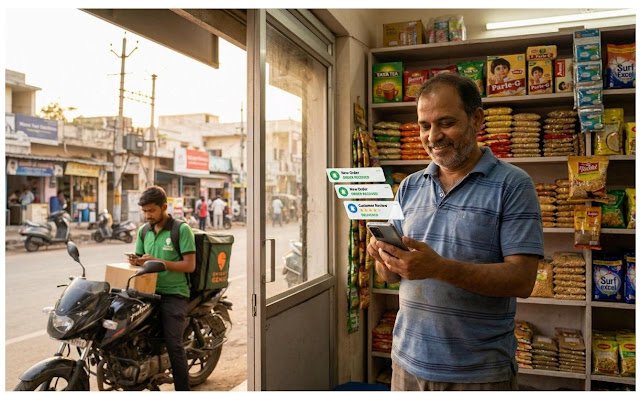
commerce is no longer a metro-only trend or a niche convenience channel. Across
India, consumers are increasingly ordering groceries, personal care products,
and household essentials in under 10 minutes, and doing so as part of their
everyday routine. What began as an urban experiment has quickly become one of
the fastest-growing retail formats in the country.
According
to Mordor Intelligence, India’s quick commerce market is projected to reach
$3.65 billion, with platforms now expanding across more than 80 cities. At the
same time, grocery and FMCG categories are seeing nearly 38 percent
year-on-year growth on these platforms, as per SaaSUltra. This shift is not
just scale-driven. It is behavioural and structural.
The Perception Problem
For
many small and regional FMCG brands, quick commerce still feels out of reach.
There is a lingering perception that platforms like Blinkit, Zepto, and Swiggy
Instamart are built primarily for large national or well funded D2C brands.
That
assumption is rapidly becoming outdated.
As
the platforms expand into Tier 2 and Tier 3 markets, including cities like
Cuttack, Raipur, Patna, Guwahati, Shillong, and Agartala, they are actively
looking for products that resonate with local consumers. This includes regional
snack brands, local spice manufacturers, and state level personal care labels
that already enjoy strong loyalty in their home markets.
The
demand is there. The gap lies in access.
What Actually Makes Quick Commerce Hard for Smaller Brands
The
barriers to entry into quick commerce are real, but they are not
insurmountable.
Unlike
traditional distribution, quick commerce requires consistent supply, strict
packaging and labelling compliance, and the ability to manage high-frequency
inventory replenishment. Operations become more complex when brands attempt to
scale across multiple cities at once.
Working
capital also becomes a constraint. Faster inventory cycles and platform-driven
payout structures can put pressure on cash flows, especially for growing
businesses. In addition, most regional brands do not have dedicated teams to
manage platform operations, compliance, and performance tracking.
This
combination of operational and financial challenges has historically kept
smaller players on the sidelines, leading to the rise of quick commerce
enablement platforms.
How Quick Commerce Enablement Brands like PickQuick Are Changing the
Equation
PickQuick,
built specifically to reshape the landscape by solving this problem for brands
that lack quick commerce infrastructure. Instead of building capabilities from
scratch, the partner brands can simplify entry and scale.
Through
PickQuick, a regional brand can get listed on Blinkit, Zepto, Swiggy Instamart,
and JioMart across multiple cities without setting up separate operations for
each, acting as an operational bridge, enabling brands to go live across these
platforms through a single integrated system.
The
onboarding process is structured and efficient; it involves managing listings,
compliance, and platform integrations centrally, allowing brands to launch
across multiple cities simultaneously rather than expanding one location at a
time. This is especially valuable for regional brands looking to move beyond
their home markets.
Simplifying Operations and Financial Barriers
Once
live, PickQuick continues to handle inventory tracking, replenishment, and
performance monitoring. This reduces the need for brands to build large
internal teams and allows them to focus on product quality and demand
generation.
Importantly,
PickQuick’s working model also addresses the financial barrier. By operating on
a structure that reduces upfront inventory burden, it makes participation in
quick commerce far more accessible without requiring significant capital
investment.
This
is a critical advantage for businesses in emerging markets across Odisha, the
Northeast, and other Tier 2 and Tier 3 regions. With over 47 brands already
onboarded across more than 31 cities, PickQuick is demonstrating that scale in
quick commerce is no longer reserved for large enterprises alone.
Why 2026 Is the Right Time to Move
Timing
plays a crucial role in any new distribution channel.
Quick
commerce is still in its expansion phase. Coverage is increasing, consumer
adoption is accelerating, and category depth is improving. According to
DemandSage, the sector is also expected to generate over 2.4 million
blue-collar jobs by 2027, indicating the scale at which infrastructure is being
built.
For
regional brands, this creates a window of opportunity with the oncoming of
quick commerce enablement platforms.
Those
with strong local recall already understand their consumers and have proven
demand. Products like packaged namkeen, regional masalas, and herbal personal
care ranges are well suited to the high-frequency, convenience-driven nature of
quick commerce.
The Road Ahead for Regional Brands
With
operational complexity and financial barriers reducing, entry into this channel
is no longer dependent on size alone. It is increasingly about readiness and
execution.
As
PickQuick and other quick commerce enablement platforms expand, 2026 could be
the year regional brands finally get their fair share of the quick commerce
boom.